 |
|
|
|
|
|
|
|
|
|
|


| S.V.A. Editor's Observations:
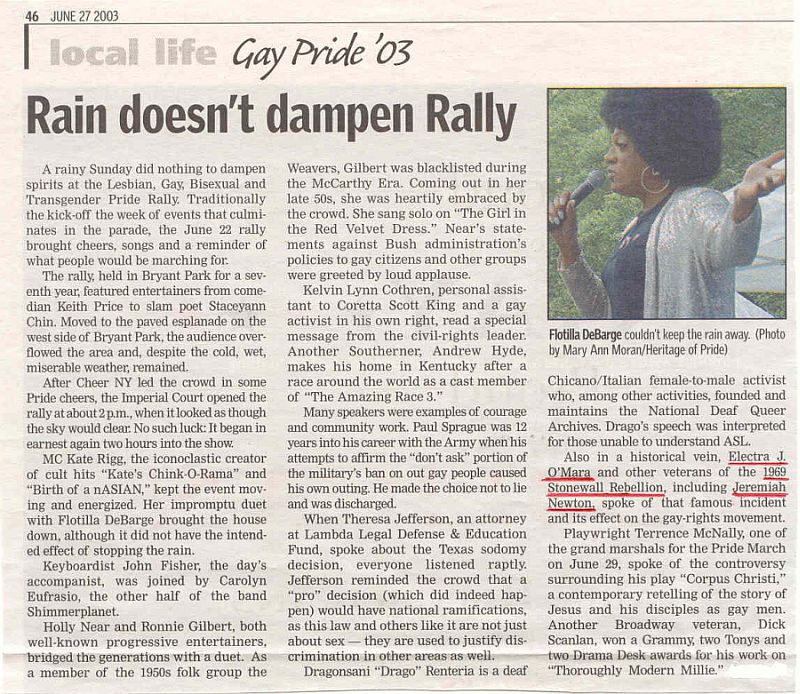
Both Electra O'Mara,
S.V.A.
Secretary,
and Jeremiah Newton,
S.V.A. President, are
elected officers of the STONEWALL
Rebellion Veterans' Association ("S.V.A."),
both
unequivocably representing the S.V.A. -- as arranged through the S.V.A.
-- at the annual Gay Pride Rally. This reality was
printed in the program, announced before they enetered the stage
and stated a few times by each: STONEWALL Veterans' Association!!
Somehow, that rudimentary fact was
unfortunately
overlooked by the unnamed New York Blade author. Yet, if it was a
{paid}
speaker from ESPA, e.g., you can be sure that ESPA would have been
mentioned over and over -- or else! Some folks think that the City of New York came with
the bridges and tunnels in place. Anyway, now that WE, in part, cleared up the annual Gay Pride Rally history basics... at Williamson's urging and coaching, Electra opened the S.V.A. rally segment with the famous crowd-pleasing "S-T-O-N-E-W-A-L-L Cheer". Electra O'Mara -- as a woman (all the other years, except "SW-25", this was done by a male) -- was a fine surprise treat for the crowd with her version of "Give me an 'S', give me a 'T', give me an 'O', give me an 'N', give me an "E", etc. Whaddya got? S-T-O-N-E-W-A-L-L!" Electra then introduced her fellow S.V.A. officer on stage. Jeremiah Newton presented the audience with a nutshell of the 1969 Stonewall Rebellion for Gay rights and clarified, once again, that the uprising was not a 'riot' and much more akin to the Boston Tea Party! S.V.A. President Jeremiah also provided an interesting synopsis history of the S.V.A. |
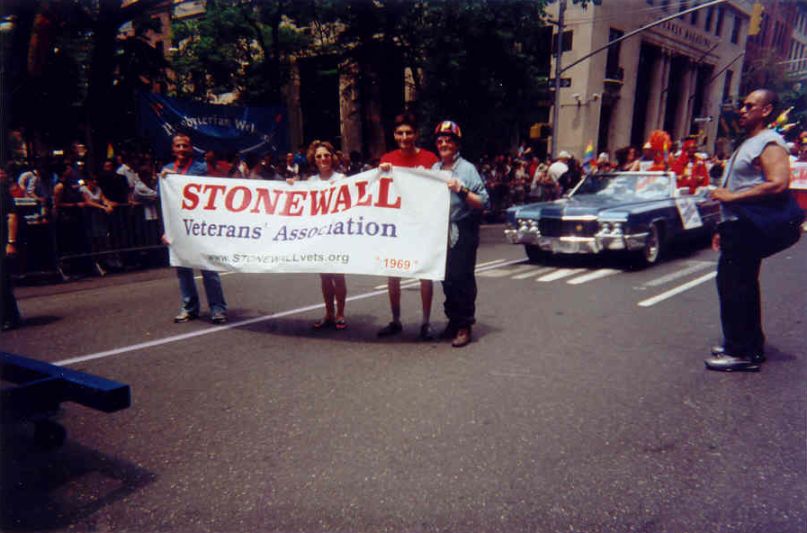
| Pictured with the STONEWALL Rebellion Veterans Association banner are (l-2-r): Gregory Curatolo, Gay Computer Center Manager and Honorary Banner Guard; Aubrey Lees, newly-elected (yesterday) S.V.A. President; Steven Gradman, Vice-President of PRIDE Democrats of NYC and Honorary Banner Guard; and Stormé DeLarverie, S.V.A. Ambassador. Following the banner is, of course, the unmistakable, classic and famous 1969 "Stonewall Car". Freely standing to the right is Friend-of-SVA (and Security Man for the vehicle) Joe Rose of Spanish Harlem. |
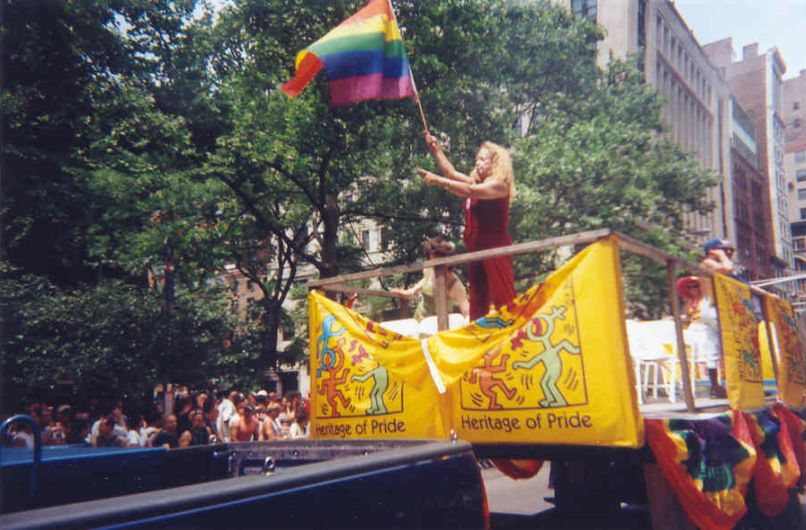
| Standing above -- you needed to climb up a ladder to get on it -- are (l-2-r): Cristina Santiago Hayworth, S.V.A. Ambassadress (up from Puerto Rico) and at the rear of the improperly labelled, unappetizing "float" reluctantly provided by the chintzy Heritage of Pride ("HOP"), Princess Jenni June Egan, Vice-President of the Imperial QUEENS & Kings of Greater New York and Friend-of-SVA (with big, colorful hat and shades); Dave West, S.V.A. Public Relationist (wearing vintage baseball uniform -- minus the shirt -- and momentarily visiting the few, isolated "float" vetz; and Bert Coffman, S.V.A. Vice-President (wearing shades, partially hidden) and very unhappy to be on this HOP farm truck. This horrendous, non-parade vehicle was dumped on the S.V.A. -- instead of a promised real parade float -- by the Heritage of Pride ("HOP"). After all, if HOP finally provided (with other people's money) an auxillary vehicle for the first time ever for the STONEWALL Rebellion Veterans Association, then why put their totally inappropriate HOP signs all over it?! Would anyone looking at the busy "HOP" banners think there are legendary Stonewall veterans up on that mislabeled old farm flatbed? Of course, not! Does HOP do that when they provide a float for other groups? Of course -- not! Is it because HOP has increasingly become more and more disrespectful, rude and tacky? Whatever, that's why barely any S/W-Vet would even go on the 'potato farm truck' -- short of prodding with a hot-burnin' cattle branding iron -- and why so many have stopped participating in the NYC Gay Parade altogether! |
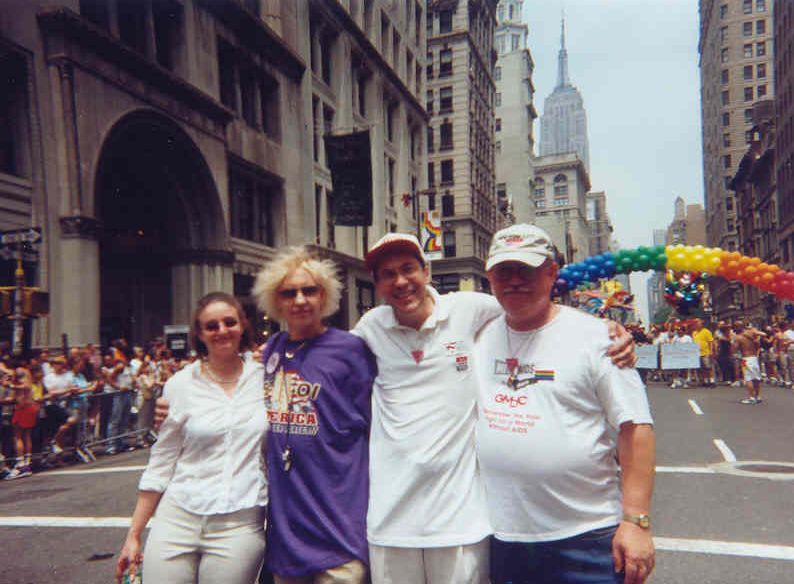
| Pictured above are (l-2-r): Tara Ann Rothschild, Friend-of-SVA; Willson L. Henderson, S.V.A. Director; Greg Lambert, S.V.A. Community Liaison; and Will Weder (the other half of "Will & Greg"). In the background -- 15 blocks north -- is the now even more symbolic New York Empire State Building. |
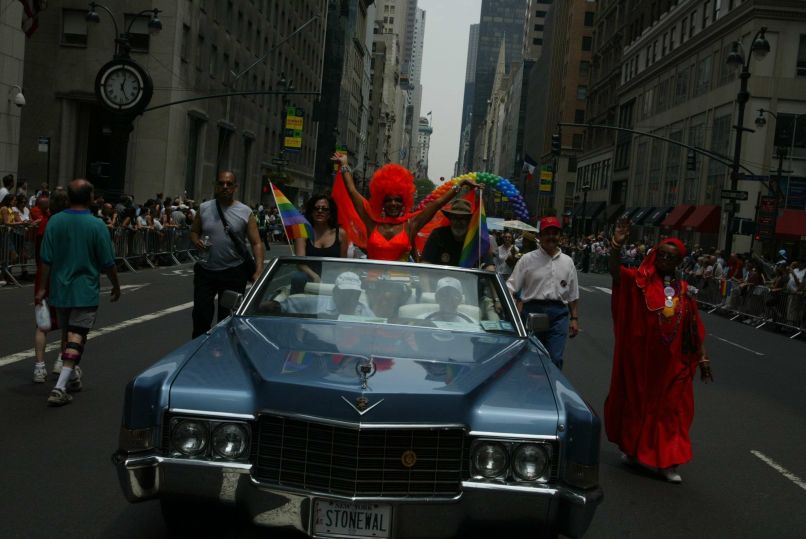
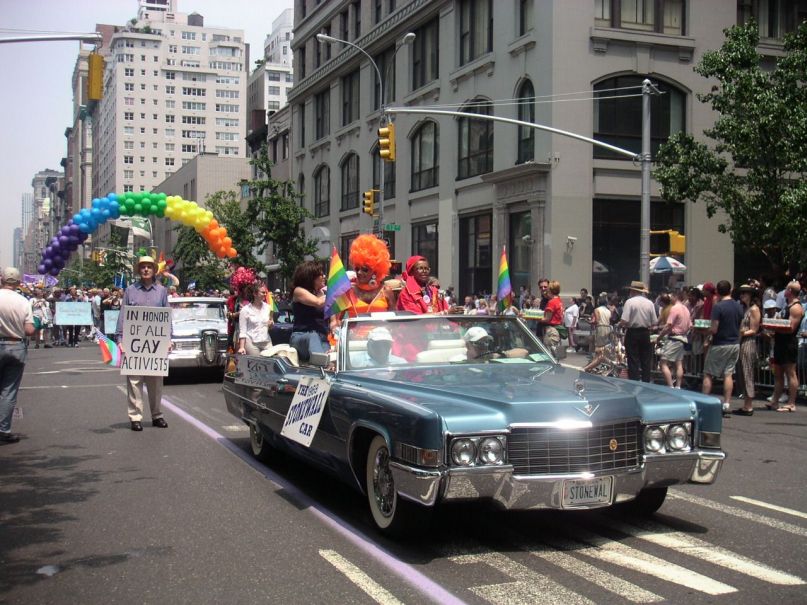
| Pictured above are (l-2-r): Electra O'Mara (mostly hidden, with back to camera); Mitchell Miller (with green shirt, back to camera); Joe Rose (walking with H2O bottle); Dianne Yodice (sitting atop back seat, left); Amir Qaharr (ridin' shotgun); Chyna Fucito (glowing in orange, back seat center); Ray McCaffrey (with white cap and shades, driving "Big Blue"); Hal Weiner (with white beard and brown hat, sitting atop back seat on the rite); Edwin Marcial (with red cap), Friend-of-SVA and one of many political opponent Council candidates against "Philis Read"; and Rev. Magora Kennedy (talking, walking, waving and wearing red). In the right rear you can see Tara Ann Rothschild (with shades and white blouse). |
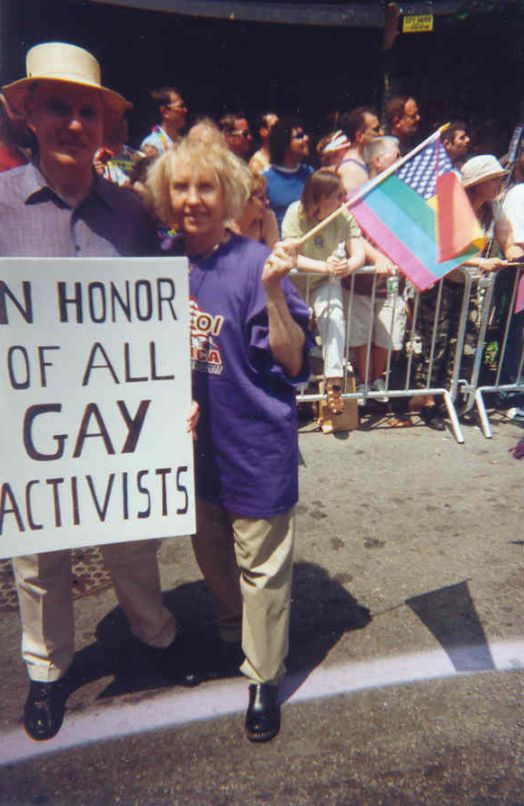
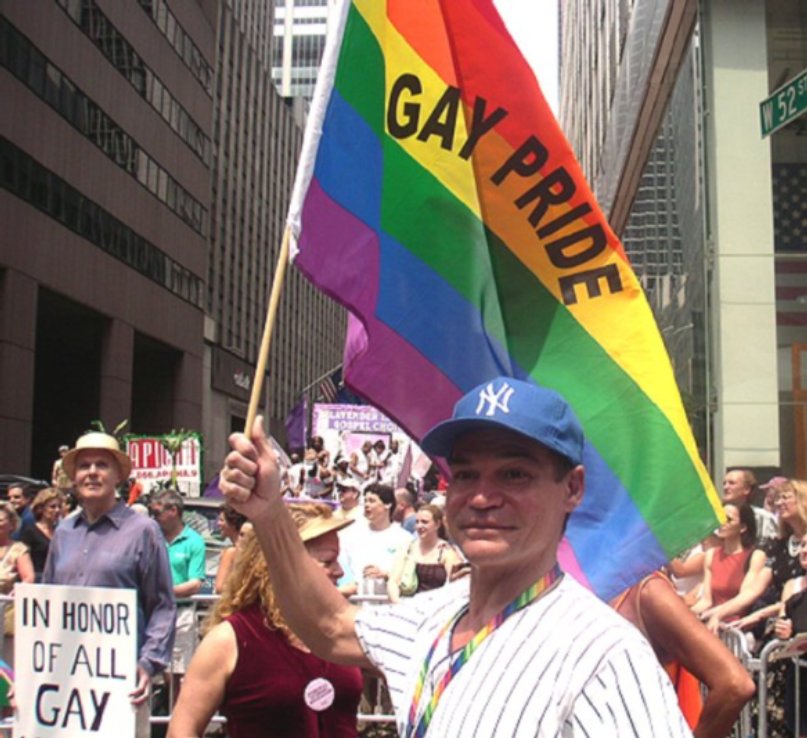
| Pictured above during a brief parade stop on crowded Christopher Street -- the gayest street in the world -- are "Towering" Jack Rojas with his perennial sign, "In Honor of All Gay Activists", and S.V.A. founder Willson Henderson, wearing a purple shirt which reads "9-11-01: America Will Never Forget", showing the likeness of the Twin Towers set against the background of an American flag. Both relevant messages are eternally entwined in recalling, remembering and reflecting on those who have been lost. |
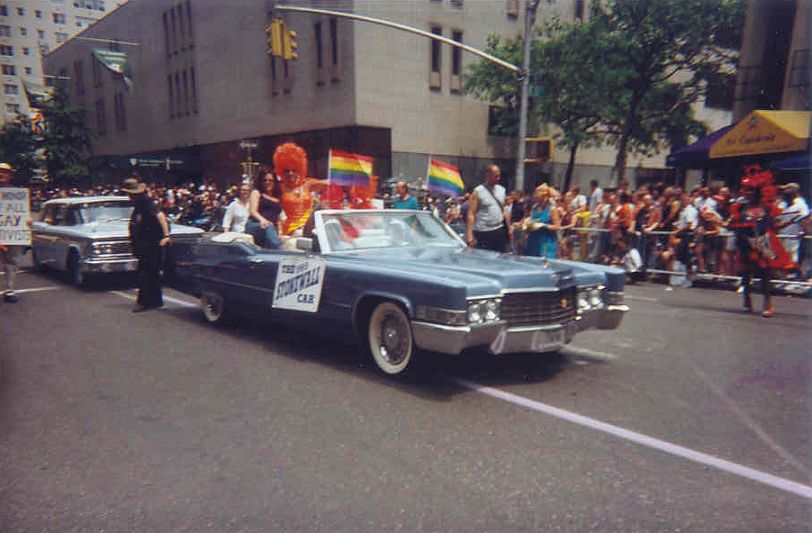
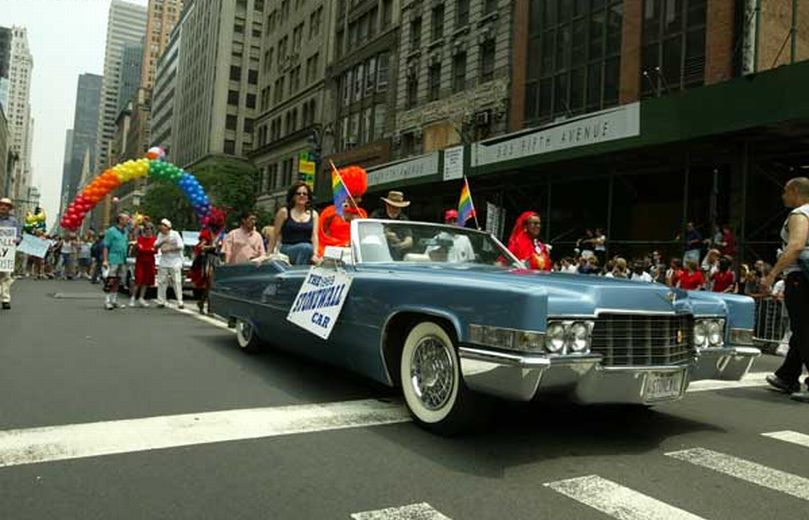
| Driving the magnificent blue beauty is reliable Ray Jay McCaffrey, STONEWALL Veterans' Association Financial Secretary (who donated the car's new brakes, which were finally needed since the last pair in 1979) and ridin' shotgun is Amir Qaharr, S.V.A. Chief-of-Security (appropriately dressed as "Men in Black"). Sitting atop the back seat of the "Stonewall Car" are (l-2-r): Dianne Yodice, S.V.A. Social Committee (with shades); Chyna Fucito, S.V.A. Executive Committee (in orange outfit and orange hair); and the legendary Hal B. Weiner, Esq., S.V.A. Legal Advisor (with safari hat). Walking alongside the car (as she refused to ride on that potato farm truck 'float') is Rev. Magora Kennedy, S.V.A. Chaplain (in beautiful red African garb). Standing in rear of photo are (l-2-r): Mitchell Miller, Friend-of-SVA; Electra O'Mara, S.V.A. Recording Secretery; and Greg Lambert, S.V.A. Liaison (with white cap). In front of them is D/Q Louisa Vasquez. The car following the S.V.A. car is Scot Allyn's unique 1959 Edsel. Ridin' shotgun in the Edsel with Scot is Melanie Gooding (Cuba's cousin). |

| Camping it up above on Christopher
Street are (l-2-r): Aubrey Lees, current, newly-elected S.V.A.
President; Willson Henderson,
the first S.V.A. President; and Rev. Magora Kennedy,
the SVA's colorful Chaplain. In the background is the
blue "Stonewall Car" of 1969 Stonewall Rebellion fame -- the only vehicle 'impounded' by the NYCPD!. |
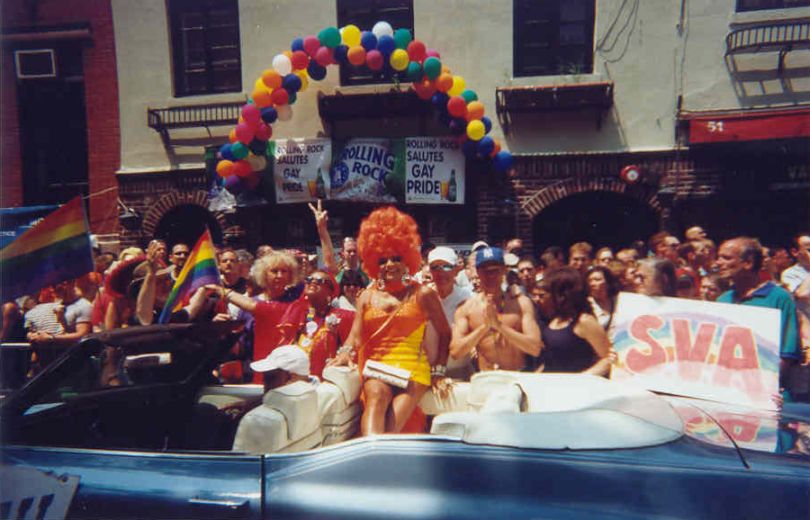
Stonewall Vetz arrive with the "Stonewall Car" at the Stonewall Club
on Stonewall Place during the "Stonewall Parade" for the "Stonewall
Prayer" and the "Stonewall Portrait"
[Photo by Leigh McManus]
This is the historic front of The STONEWALL Club during the parade -- with approximately 1,000 people proudly packed on the block. The 1969 "Stonewall Car" is stopped right in front of the club. Pictured to the left (literally) of the car's rainbow flag is the renowned Hal Weiner (with black leather hat and arm raised). To the right of the flag is Willson L. Henderson (in purple tee shirt with fingers' peace sign), Amir Qaharr (with white cap sitting in front seat of car), Rev. Magora Kennedy (in red outfit with arms outstretched), Chyna Fucito (in orange sitting on side of car), Ray McCaffrey (with white cap), Dave West (with blue cap and bare-chested), Dianne Yodice (with head turned, blabbing away), Electra O'Mara (holding S.V.A. sign) and Mitchell Miller (in turquoise shirt). Other Stonewall Vetz were in front of, behind and on other side of the flagship "Stonewall Car". Oh, incidentally, in the background on the far left side is IQKNY's lovely Princess Jenni June Egan (wearing the big red hat). In the parade, Jenni was stuck ridin' up top on that ugly, old farm wagon disrespectfully 'provided' via Heritage of Pride (free to HoP by the Bond Float Company) and rudely plastered with their HOP signs not S.V.A.!
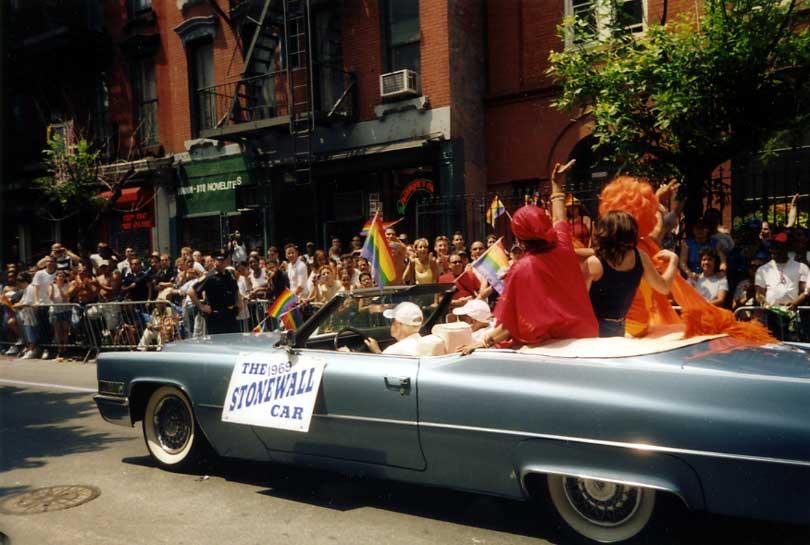
| Driving the magnificent classic vehicle very gingerly in front of the adoring crowds is the SVA's popular Financial Secretary Ray McCaffrey. Riding shotgun (also wearing a white cap) is S.V.A. big tough guy vet Amir Qaharr. Sitting across the top with colorful backs to the camera are (l-2-r): Reverend Magora Kennedy (red), Dianne Yodice (blue) and Countess Chyna Fucito (orange). |
Readers
responses to an informative Gay Pride Story in The Blade
for Gay Pride Weekend on the STONEWALL Veterans' Association
|
|||

30 October
2020
*
|
|
|
|
|
|
